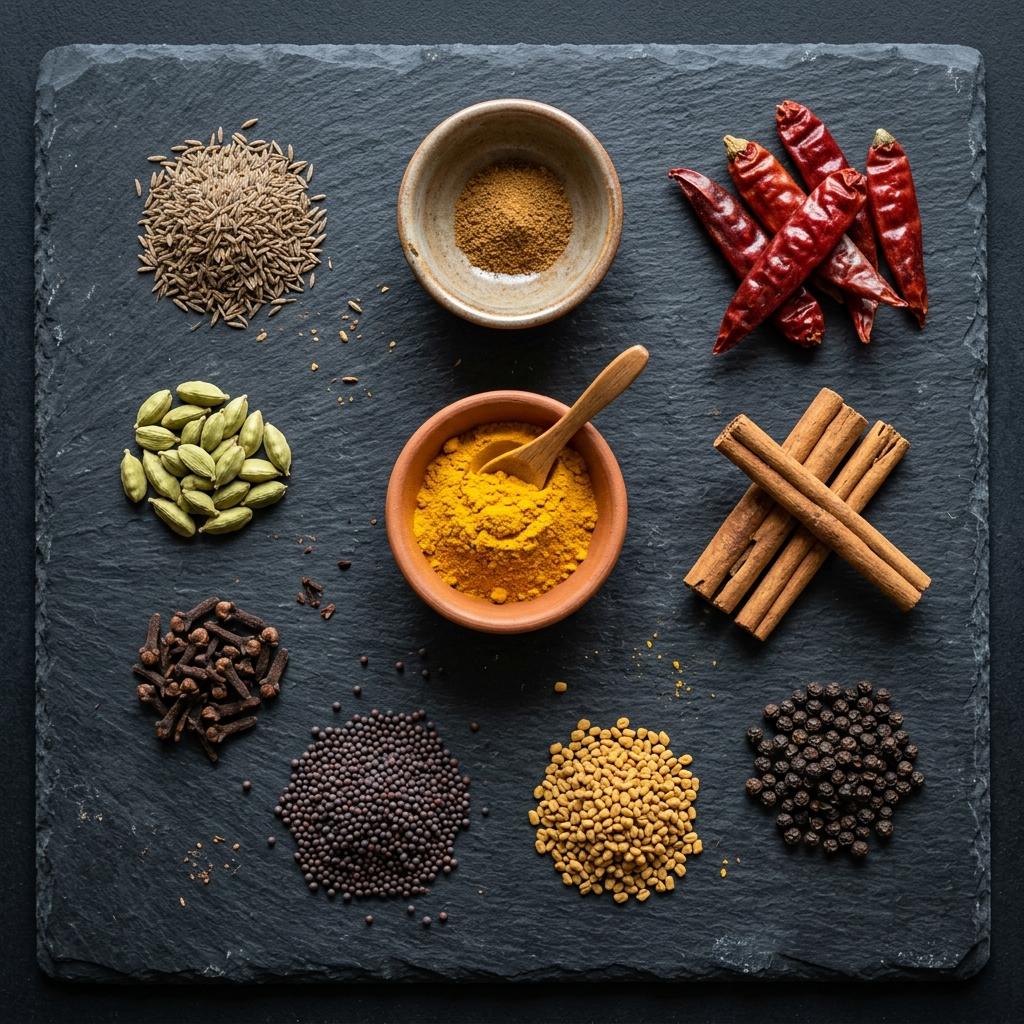
The spices every Indian kitchen runs on
A practical guide to the 9 spices that show up across Indian regional cooking — what they taste like, when they go in, and what they actually do in a dish
The spices every Indian kitchen runs on
If you're stocking a kitchen for Indian cooking, the spice shelf can feel like a problem. There are too many jars, too many names, too many recipes that assume you already know what goes in. But most Indian cooking — across regions — draws from a shorter list than you'd expect. You don't need 40 jars. You need maybe 10, used well.
What follows covers the spices that appear repeatedly across North Indian, South Indian, and Bengali cooking. Not every spice used in every region. The ones worth learning first.
Cumin (jeera)
Whole cumin seeds are almost always the first thing into hot oil. When you make a dal tadka, a sabzi, or the base of most curries, jeera goes in first. The seeds splutter when the oil is hot enough — that sound is your signal.
Ground cumin is a different ingredient in practice: earthier, less sharp, slower to release. It goes into masalas and marinades. The two forms aren't interchangeable and shouldn't be treated as such.
Cumin turns up in chhole, jeera rice, dal tadka, raita, chaat. If there's one spice that works across every Indian regional cuisine, this is probably it.
Coriander (dhania)
Ground coriander is used in huge quantities in Indian cooking and gets very little credit for it. The flavour is mild and citrusy with a faint warmth. It doesn't announce itself. What it does is soften a masala and give it body — it's rarely used alone, always in combination.
Whole coriander seeds appear in some spice blends and pickles but are less common in everyday cooking. Fresh coriander leaves are a separate ingredient entirely and shouldn't be confused with the ground spice.
Ground coriander is in sambar powder, garam masala, chole masala, and virtually every sabzi spice blend. It's the spice doing quiet background work in most dishes you'd recognise.
Turmeric (haldi)
Bright yellow-orange, earthy, slightly bitter, with a faint sharpness that reads a little like raw mustard. A quarter teaspoon is usually enough. More than that and it starts to overpower.
It goes in early — often with the onions or garlic — and needs to cook out in the oil. Raw turmeric has a harsh, almost medicinal edge. Cooked turmeric is softer and more mellow. They genuinely taste different, so timing matters.
Turmeric appears in dal, sabzi, rice, marinades, haldi doodh, and is especially prominent in South Indian cooking — sambar, rasam, kootu all use it. It's also in almost every spice blend you'll encounter.
Mustard seeds (rai / sarson)
Black mustard seeds (rai) are the starting point for most South Indian and a lot of Bengali cooking. They go into hot oil at the very beginning of a dish and need to pop before anything else goes in. If they don't pop, the oil isn't hot enough. If they burn, they turn bitter and sharp in an unpleasant way. Start again.
Before popping, the flavour is harsh. After popping in hot oil, nutty and mild. That change is the whole point of the tadka — it's not just heating, it's chemistry.
Essential in sambar, rasam, chutneys, most South Indian vegetable dishes. In Bengali cooking, mustard is also used as a paste, which is a completely different application of the same seed. In North Indian cooking, mustard seeds appear less often in day-to-day sabzis.
Dried red chillies (sukhi lal mirch)
Whole dried red chillies go in with the tadka. In hot oil, they blister and deepen. The heat they add is different from chilli powder: slower to develop, less raw, more integrated into the dish.
Heat level varies a lot between varieties. Kashmiri chillies are mild and used mainly for the deep red colour they give to oil and dishes. Guntur chillies from Andhra Pradesh are significantly hotter. Most recipes don't tell you which variety to use, which is one reason the same dish can taste very different depending on who's cooking it.
Dried red chillies appear in sambar, rasam, chutneys, Bengali cooking, and most North Indian masalas. They're used whole in tadka and ground into spice blends.
Cardamom (elaichi)
Green cardamom is floral and slightly cooling, with a faint eucalyptus quality. It's one of the more immediately recognisable smells in Indian cooking. It works in both savoury and sweet — biryani and pulao on one side, kheer, halwa, and chai on the other.
In savoury cooking, whole pods go into the tadka alongside cloves and cinnamon. You don't eat them; they do their work and get pushed to the side of the plate. Green cardamom is also ground into garam masala.
Black cardamom (badi elaichi) is a different spice — larger, smoky, used only in savoury dishes. If a biryani recipe calls for cardamom without specifying which kind, it means green.
Cloves (laung)
Two or three whole cloves is usually enough. They're strongly aromatic and warm, with a slight sweetness underneath. Whole cloves go into the tadka alongside cardamom and cinnamon at the start of biryani and pulao. Ground cloves appear in garam masala — they're a big part of what gives it that characteristic warmth.
If you've ever bitten into a whole clove in a rice dish by accident, you understand why they go in whole and get left on the side.
Cinnamon (dalchini)
Indian cooking uses cinnamon bark, not cinnamon powder, and it goes in whole for most savoury dishes. A small piece — a centimetre or two — into hot oil with cloves and cardamom at the start of a biryani or rich curry.
What it contributes to savoury food is warmth and depth rather than sweetness. It's different from how cinnamon is used in European baking. It's also a component of garam masala.
One practical note for anyone buying cinnamon in Germany: most supermarket cinnamon is cassia (Cinnamomum cassia), which is stronger and slightly harsher than true cinnamon (Cinnamomum verum, sometimes labelled Ceylon cinnamon). Both work in Indian cooking. The botanical difference is real but it won't ruin a dish either way.
Fenugreek (methi)
Small, hard, yellow-orange seeds with a distinctive bitter flavour — slightly sweet underneath, but predominantly bitter. Ground fenugreek has a faint maple-like quality that gets more pronounced the longer it cooks. In whole form, a small amount goes into the tadka: a quarter teaspoon or less. Too much and the bitterness takes over and doesn't let go.
Fenugreek seeds appear in sambar powder, many South Indian spice blends, and some North Indian pickles. The leaves (methi) are a separate ingredient used in sabzis, parathas, and dal methi. The seeds and leaves are related but don't taste the same.
Fenugreek is the spice most people mess up by using too much. If a dish tastes inexplicably bitter, that's usually what happened.
A note on garam masala
Garam masala goes in at the end of cooking, not the beginning. It's a blend of several spices listed here — typically cardamom, cloves, cinnamon, black pepper, and sometimes cumin — and the exact mix varies by region and brand. Adding it at the start of cooking burns off the aromatics that make it worth using.
Aahaar stocks garam masala alongside a range of pre-blended masalas from Everest — chaat masala, chole masala, rajma masala, tandoori chicken masala. If you're not yet blending your own, these are a solid place to start.
Try these products
All the whole spices listed here are available in the Spices & Masalas section, along with pre-blended masalas for when you'd rather not measure out seven things.
Whole spices:
- Jeera Whole — Cumin Seeds 100g
- Mustard Seeds 100g
- Cardamom Green 50g
- Cloves 50g
- Dalchini — Cinnamon 50g
- Methi Seeds — Fenugreek Seeds
- Turmeric — Haldi Powder 100g
- Dhaniya Whole — Coriander Seeds 100g
Masalas: